Note
Go to the end to download the full example code.
TiO2/SiO2 Bragg mirror
TiO2/SiO2 Bragg mirror simulation
Authors: O. Castany, M.Müller
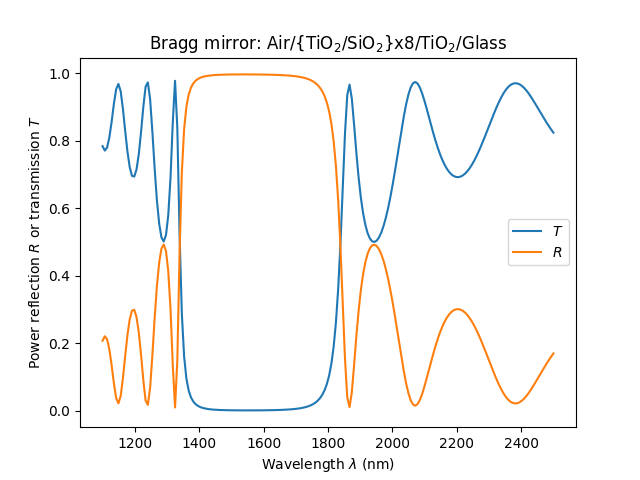
This notebook simulates a Bragg mirror composed of alternating layers of TiO₂ and SiO₂, each a quarter-wavelength thick at a central wavelength of 1550 nm. The mirror contains 8.5 periods, with air as the incident medium and glass as the substrate.
import elli
import elli.plot as elliplot
import matplotlib.pyplot as plt
import numpy as np

np.set_printoptions(suppress=True, precision=3)
Material definition
We define all required materials with constant (non-dispersive) refractive indicies. Air as incidence material and glass as exit material. The Bragg mirror materials are SiO2 and TiO2.
air = elli.AIR
glass = elli.ConstantRefractiveIndex(1.5).get_mat()
SiO2 = elli.ConstantRefractiveIndex(1.47).get_mat()
TiO2 = elli.ConstantRefractiveIndex(2.23 + 1j * 5.2e-4).get_mat()
Create layers and structure
The SiO2 and TiO2 layers are set to the thickness of an quarterwaveplate of the respective material at 1550 nm.
Thickness of the SiO2 QWP: 263.6054421768708 nm
Thickness of the TiO2 QWP: 173.76681614349775 nm
Create layers and structure
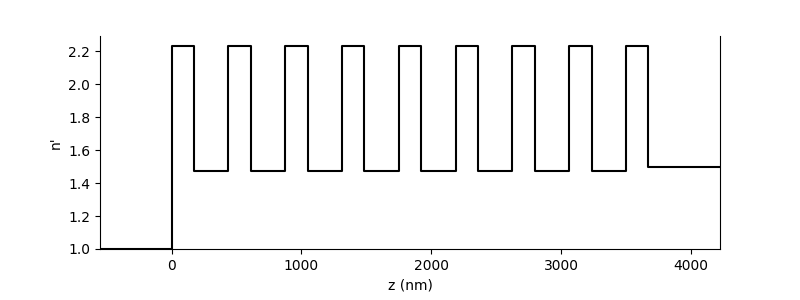
We now build the multilayer stack: Alternating layers of TiO2 / SiO2: - 8 full periods + 1 TiO2 layer at the end → “8.5 periods” - Placed between air (front) and glass (back)
# Define periodic stack
# Repeated layers: 8.5 periods: Parameters (Substructure, repetitions, number of layers before, number of layers after the stack)
layerstack = elli.RepeatedLayers([L_TiO2, L_SiO2], 8, 0, 1)

# Build full structure
s = elli.Structure(air, [layerstack], glass)
Structure Graph: Visualization of the refractive index profile in z-direction.
elliplot.draw_structure(s)
<Axes: xlabel='z (nm)', ylabel="n'">
Optical calculation
Calculation of the reflection and transmission of the structure at normal incidence (0°).
Reflection and Transmission data
The plot shows the high reflection in the stopband region around the design wavelength and the interference patterns around it.
fig = plt.figure()
ax = fig.add_subplot(1, 1, 1)
ax.plot(lbda_list, T, label="$T$")
ax.plot(lbda_list, R, label="$R$")
ax.legend(loc="center right")
ax.set_xlabel(r"Wavelength $\lambda$ (nm)")
ax.set_ylabel(r"Power reflection $R$ or transmission $T$")
ax.set_title(r"Bragg mirror: Air/{TiO$_2$/SiO$_2$}x8/TiO$_2$/Glass")
plt.show()
Total running time of the script: (0 minutes 0.240 seconds)