Note
Go to the end to download the full example code.
Custom fitting example
This is a short example for fitting data, which is not covered by the fitting widget. It relies on calling lmfit manually. Therefore one needs to provide a fitting function, which calculates the numerical residual between measurement and model. This notebook is about fitting multiple datasets from different angles of incidents simultaneously, but can be adapted to a wide range of different use cases.
import numpy as np
import elli
from elli.fitting import ParamsHist
from lmfit import minimize, fit_report
import matplotlib.pyplot as plt
Data import
Setting up invariant materials and fitting parameters
rii_db = elli.db.RII()
Si = rii_db.get_mat("Si", "Aspnes")

params = ParamsHist()
params.add("SiO2_n0", value=1.452, min=-100, max=100, vary=True)
params.add("SiO2_n1", value=36.0, min=-40000, max=40000, vary=True)
params.add("SiO2_n2", value=0, min=-40000, max=40000, vary=False)
params.add("SiO2_k0", value=0, min=-100, max=100, vary=False)
params.add("SiO2_k1", value=0, min=-40000, max=40000, vary=False)
params.add("SiO2_k2", value=0, min=-40000, max=40000, vary=False)
params.add("SiO2_d", value=20, min=0, max=40000, vary=True)
Model helper function
This model function is not strictly needed, but simplifies the fit function, as the model only needs to be defined once.
def model(lbda, angle, params):
    SiO2 = elli.Cauchy(
        params["SiO2_n0"],
        params["SiO2_n1"],
        params["SiO2_n2"],
        params["SiO2_k0"],
        params["SiO2_k1"],
        params["SiO2_k2"],
    ).get_mat()

    structure = elli.Structure(
        elli.AIR,
        [elli.Layer(SiO2, params["SiO2_d"])],
        Si,
    )

    return structure.evaluate(lbda, angle, solver=elli.Solver2x2)
Defining the fit function
The fit function follows the protocol defined by the lmfit package and needs the parameters dictionary as first argument. It has to return a residual value, which will be minimized. Here psi and delta are used to calculate the residual, but could be changed to transmission or reflection data.
def fit_function(params, lbda, data):
    residual = []

    for phi_i in [50, 60, 70]:
        model_result = model(lbda, phi_i, params)

        resid_psi = data.loc[(phi_i, "Ψ")].to_numpy() - model_result.psi
        resid_delta = data.loc[(phi_i, "Δ")].to_numpy() - model_result.delta

        residual.append(resid_psi)
        residual.append(resid_delta)

    return np.concatenate(residual)
Running the fit
The fitting is performed by calling the minimize function with the fit_function and the needed arguments. It is possible to change the underlying algorithm by providing the method kwarg.
[[Fit Statistics]]
    # fitting method   = leastsq
    # function evals   = 119
    # data points      = 3546
    # variables        = 3
    chi-square         = 157.748841
    reduced chi-square = 0.04452409
    Akaike info crit   = -11031.1779
    Bayesian info crit = -11012.6572
[[Variables]]
    SiO2_n0:  1.63549687 +/- 0.03012997 (1.84%) (init = 1.452)
    SiO2_n1:  27.6408772 +/- 8.75248306 (31.66%) (init = 36)
    SiO2_n2:  0 (fixed)
    SiO2_k0:  0 (fixed)
    SiO2_k1:  0 (fixed)
    SiO2_k2:  0 (fixed)
    SiO2_d:   1.75831329 +/- 0.02404272 (1.37%) (init = 20)
[[Correlations]] (unreported correlations are < 0.100)
    C(SiO2_n0, SiO2_d)  = -0.9916
    C(SiO2_n0, SiO2_n1) = -0.9596
    C(SiO2_n1, SiO2_d)  = +0.9259
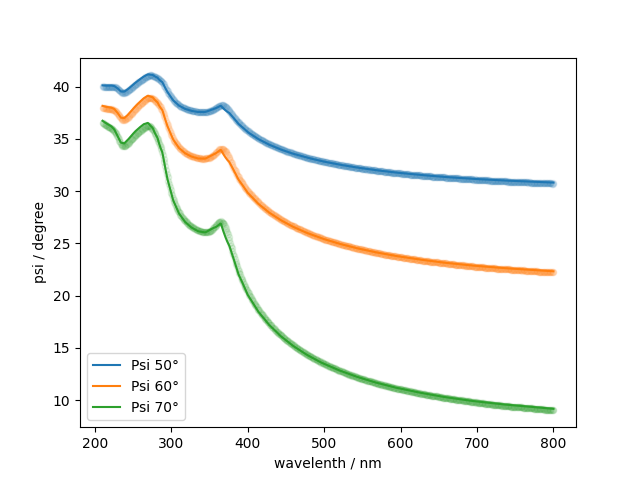
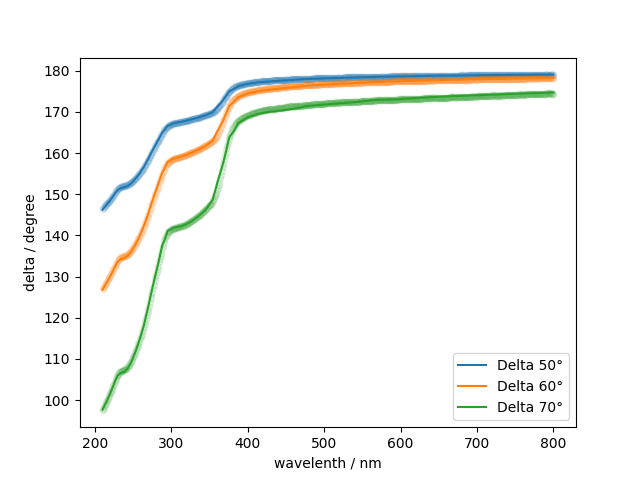
Plotting the results
fit_50 = model(lbda, 50, out.params)
fit_60 = model(lbda, 60, out.params)
fit_70 = model(lbda, 70, out.params)

fig = plt.figure(dpi=100)
ax = fig.add_subplot(1, 1, 1)
ax.scatter(lbda, data.loc[(50, "Ψ")], s=20, alpha=0.1, label="50° Measurement")
ax.scatter(lbda, data.loc[(60, "Ψ")], s=20, alpha=0.1, label="Psi 60° Measurement")
ax.scatter(lbda, data.loc[(70, "Ψ")], s=20, alpha=0.1, label="Psi 70° Measurement")
(psi50,) = ax.plot(lbda, fit_50.psi, c="tab:blue", label="Psi 50°")
(psi60,) = ax.plot(lbda, fit_60.psi, c="tab:orange", label="Psi 60°")
(psi70,) = ax.plot(lbda, fit_70.psi, c="tab:green", label="Psi 70°")
ax.set_xlabel("wavelenth / nm")
ax.set_ylabel("psi / degree")
ax.legend(handles=[psi50, psi60, psi70], loc="lower left")
fig.canvas.draw()

fig = plt.figure(dpi=100)
ax = fig.add_subplot(1, 1, 1)
ax.scatter(lbda, data.loc[(50, "Δ")], s=20, alpha=0.1, label="Delta 50° Measurement")
ax.scatter(lbda, data.loc[(60, "Δ")], s=20, alpha=0.1, label="Delta 60° Measurement")
ax.scatter(lbda, data.loc[(70, "Δ")], s=20, alpha=0.1, label="Delta 70° Measurement")
(delta50,) = ax.plot(lbda, fit_50.delta, c="tab:blue", label="Delta 50°")
(delta60,) = ax.plot(lbda, fit_60.delta, c="tab:orange", label="Delta 60°")
(delta70,) = ax.plot(lbda, fit_70.delta, c="tab:green", label="Delta 70°")
ax.set_xlabel("wavelenth / nm")
ax.set_ylabel("delta / degree")
ax.legend(handles=[delta50, delta60, delta70], loc="lower right")
fig.canvas.draw()
Total running time of the script: (0 minutes 2.581 seconds)